
Can AI Replace Teachers? Understanding the Future of Human Teaching in an AI Era
Artificial intelligence is reshaping the way we work, learn, and communicate.
20/11/2025
AI
Table of Content
- The Real Answer: Can AI Truly Replace Teachers?
- How AI Actually Functions Inside Modern Education Systems
- What Human Teachers Offer That AI Still Cannot Replicate
- The Advantages and Limitations of AI in Today’s Classrooms
- Real-World Examples of AI Being Used in Education
- What the Future of Teaching Looks Like With AI as a Learning Partner
- Conclusion: Why Teachers Will Always Matter More Than Technology
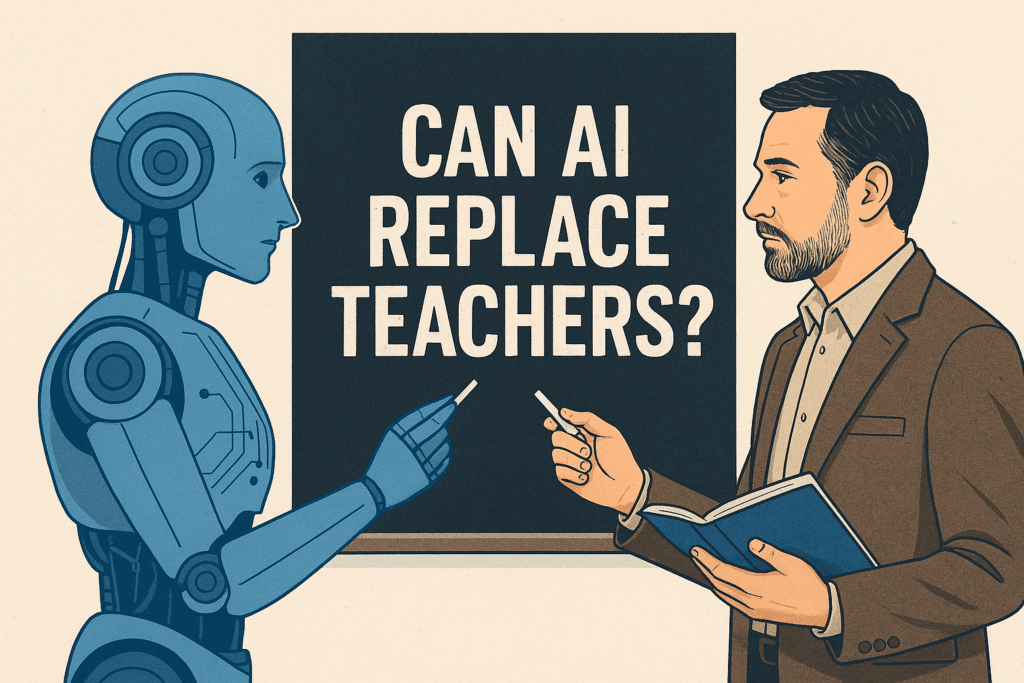
The rise of artificial intelligence has transformed almost every industry, and education is no exception. With AI tutors, automated grading, and smart learning platforms becoming mainstream, many people are now asking: can AI replace teachers?
The simple answer: No. AI can support teachers, but it cannot replace the human role in education.
Below is a clear, concise analysis of how AI works, where it fits, and why teachers will remain essential.
The Real Answer: Can AI Truly Replace Teachers?
AI is becoming an effective assistant in schools, coaching centers, and universities. Here’s how it supports education:
Personalized Learning
AI adjusts lessons based on each student’s individual pace, challenges, and strengths.
Automated Assessments
Grading objective questions, quizzes, and assignments becomes quick and consistent.
Intelligent Tutoring Systems
AI tutors and chatbots explain concepts, solve doubts, and guide students anytime.
Predictive Analytics
AI identifies students who need extra help and alerts teachers early.
Classroom & Workflow Automation
Attendance, scheduling, reminders, and resource planning become easier with AI tools.
AI improves efficiency—but does not replace the teacher’s role.
What Human Teachers Offer That AI Still Cannot Replicate
Even with advanced intelligence, AI lacks core human abilities:
Emotional Understanding
Teachers sense anxiety, confusion, excitement, or fear—AI cannot truly understand emotions.
Relationship Building
Students learn better when guided by someone who genuinely cares about their progress.
Teaching Values & Social Behavior
Teamwork, respect, discipline, empathy, and ethics come from human role models.
Creativity & Flexibility
Teachers adapt lessons based on class energy, mood, and real-time feedback—something AI cannot do.
Deep Mentorship
Students often need motivation, confidence-building, and life advice that only humans can provide.
AI delivers content.
Teachers shape character.
The Advantages and Limitations of AI in Today’s Classrooms
Like any tool, AI has both benefits and drawbacks.
Advantages
Personalized learning for every student
Reduced teacher workload
Faster grading and instant feedback
More engaging learning tools
Real-time performance insights
Limitations
No true emotional intelligence
Risk of incorrect or biased information
Students may become overly dependent
Lack of human connection
Unequal access in low-resource regions
AI is powerful—but incomplete without human educators.
Real-World Examples of AI Being Used in Education
AI tools are already making an impact:
ChatGPT & Gemini : Provide explanations, writing support, and conceptual clarity
Khanmigo : Khan Academy’s AI tutor for personalized assistance
Duolingo : AI-driven adaptive language learning
Gradescope : Automated exam and assignment evaluation
Byju’s & Vedantu : Personalized learning paths using data analytics
Google Classroom : Smart automation for tasks and organization
These tools help teachers—they don’t replace them.
What the Future of Teaching Looks Like With AI as a Learning Partner
The future of education is not teacher-free. Instead, it combines human strengths with AI capabilities.
Teachers Become Learning Facilitators
AI handles repetitive tasks; teachers focus on creativity, problem-solving, and human connection.
Highly Personalized Classrooms
AI supports each student’s learning path while teachers provide guidance and emotional support.
Immersive Learning Through AR/VR
Virtual reality and simulations will make lessons more interactive and memorable.
New Roles for Teachers
Future educators may become:
AI-assisted mentors
Digital curriculum designers
Data-driven instructors
Learning experience architects
Faster Feedback, Better Outcomes
With AI analyzing data, teachers will be able to respond to students faster and more effectively.
The future is AI-plus-teacher, not AI-versus-teacher.
Conclusion: Why Teachers Will Always Matter More Than Technology
So, can AI replace teachers?
Even with all its intelligence, AI lacks the core qualities that define meaningful education. Teaching is not just a task. It is a relationship built on trust, compassion, communication, and understanding.
AI can automate processes.
AI can personalize lessons.
AI can support learning.
But AI cannot inspire.
AI cannot mentor.
AI cannot feel.
AI cannot understand the complexities of the human experience.
The future of education is not about choosing between AI or teachers—it is about combining the strengths of both. AI will handle the technical tasks, while teachers will guide, motivate, and shape the minds and hearts of learners.
AI won’t replace teachers.
Teachers who learn to use AI will lead the next generation.